

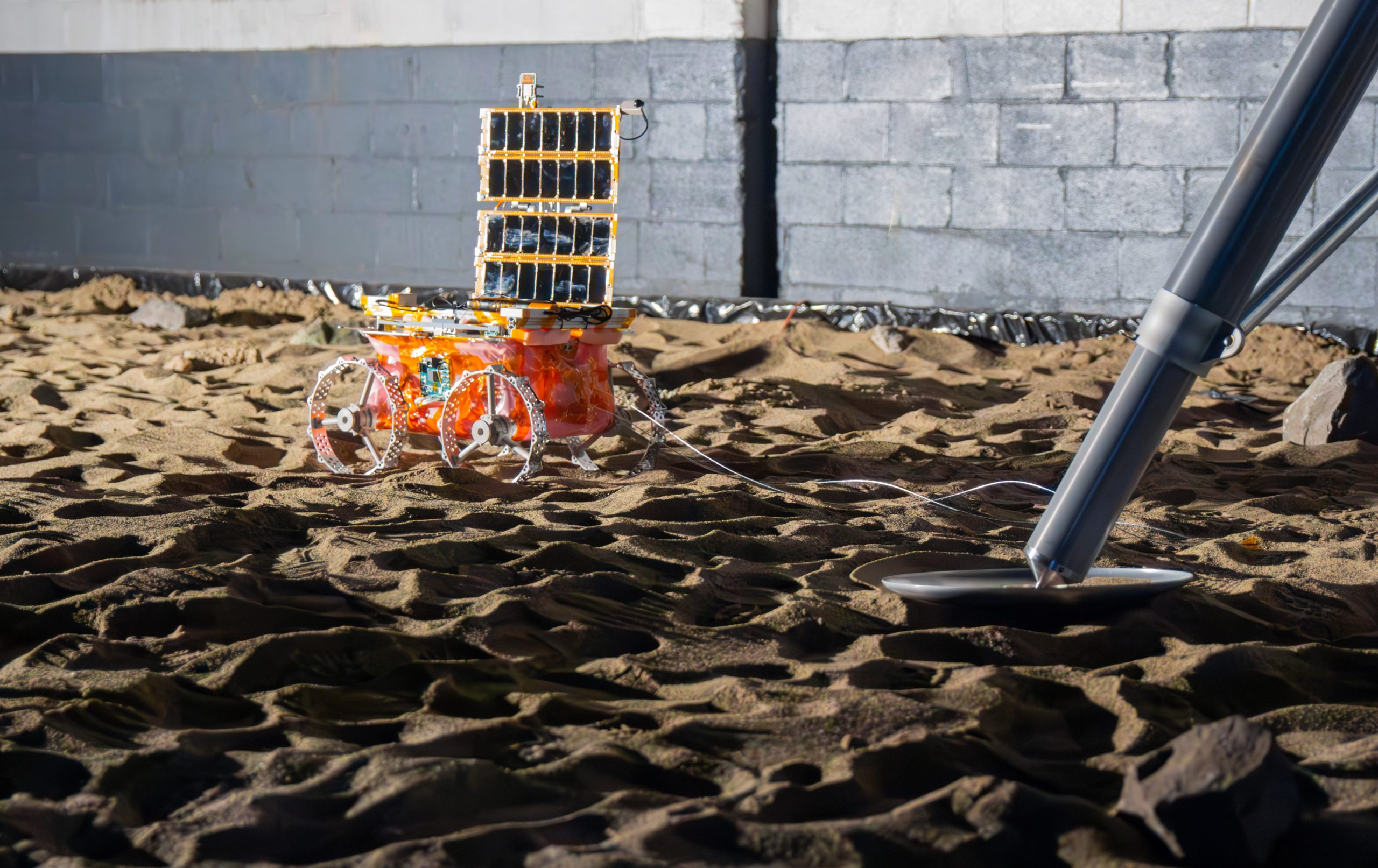
Pittsburgh, PA – August 20, 2025 – Astrobotic announced that its planned lunar power demonstration mission, LunaGrid-Lite, has reached another major development milestone and is nearing flight readiness. LunaGrid-Lite (LGL) will deploy 500m of ultra-light cable across the lunar landscape and transmit 1 kilowatt of power for the first time on the Moon using an Astrobotic CubeRover. The project has now successfully passed Critical Design Review (CDR) and has proceeded to flight component fabrication and assembly.
“Achieving this milestone marks the completion of the design and planning phase for LunaGrid-Lite, propelling us into a flight-ready system by Q2 2026,” said Matt Zamborsky, Senior Program Manager at Astrobotic. “This review confirms the maturity of our system designs and demonstrates that we are on track to deliver a mission capable of validating surface power delivery on the lunar surface.”
As part of the spacecraft design life cycle, CDR finalizes all system designs, verifies that they meet the mission’s technical and operational requirements, and secures approval from the program review board to move forward with flight hardware development.
“CDR requires each subsystem team to prove that their designs are fully defined, tested, and ready for flight hardware production,” said Thomas Joyce, Systems Engineering Lead for LunaGrid-Lite. “Engineering models have been built and tested extensively to demonstrate mission readiness. This achievement reflects the tremendous work and collaboration across our company, and we’re proud of what the team has accomplished.”
With spaceflight component production now underway, the next major milestone for LGL will be the System Integration Review (SIR), currently scheduled for the fourth quarter of 2025. During this phase, completed hardware will undergo detailed evaluation to confirm readiness for full spacecraft integration.
By successfully demonstrating power transmission on the lunar surface, LunaGrid-Lite will lay the groundwork for Astrobotic’s full-scale LunaGrid network. LunaGrid is being developed to deliver continuous and scalable power to support long-duration operations and permanent infrastructure at the lunar south pole. The system will enable extended missions through the lunar night, power scientific instruments and industrial equipment, and provide critical infrastructure for both government programs and commercial customers.
“LunaGrid represents a foundational capability for sustainable lunar exploration,” said John Thornton, CEO of Astrobotic. “Power is the essential first step in enabling everything from science and mobility to human habitation. LunaGrid-Lite is the first step toward realizing that future.”


Alex Pletta (pictured above), Software Lead for LunaGrid-Lite and Robotics Software Engineer at Astrobotic, says: “Our core technologies for this mission are rooted in heritage and best practices of aerospace and robotics design for extreme environments. We have extensively studied proven terrestrial solutions for power infrastructure and robotic construction and have now optimized them for the unique demands of lunar conditions. However, novel goals sometimes require novel solutions. Our high-voltage power converter, co-created with NASA’s Glenn Research Center, balances design extremes for low mass, high reliability, and thermal stability. The power cable is not only ultra-light, pushing the limits of efficiency and manufacturability, but is also robust to the harsh, abrasive effects of lunar regolith. While previous unmanned planetary rovers were built for scientific exploration, this rover (Astrobotic’s first 4U CubeRover) integrated with the robotic cable deployer, will be the first rover ever to deliver near-permanent infrastructure to an extraterrestrial body; this has created unique mobility, sensing, and teleoperation constraints leading to what is now our state-of-the-art perception and navigation system. Our team is doing really incredible work, and it’s so exciting to see it all coming together!”