

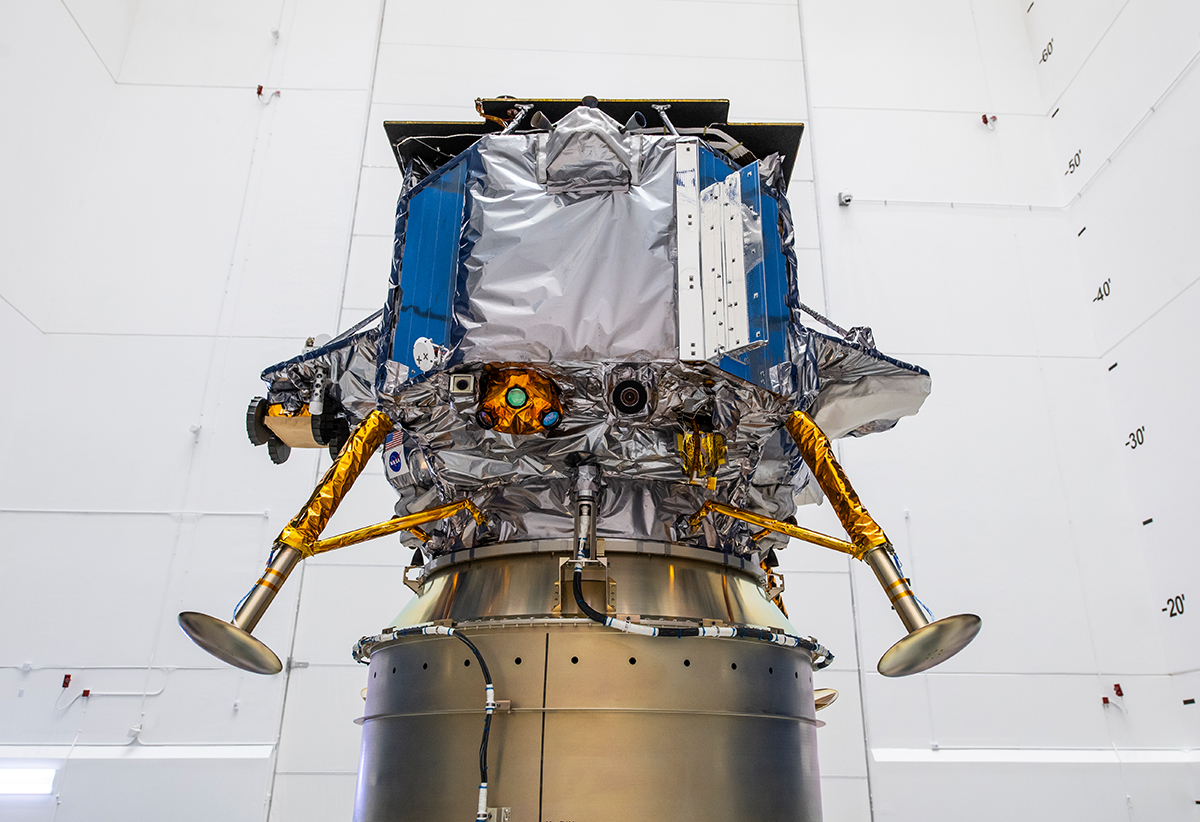
PITTSBURGH, June 30, 2026 — Astrobotic has been selected by NASA to deliver a suite of agency payloads to the lunar surface under the Commercial Lunar Payload Services (CLPS) initiative in support of NASA’s Moon Base. These Moon Base task order awards will fly two Peregrine lunar landers to the Moon by the end of 2028.
“Each mission has moved us closer to routine lunar access,” said John Thornton, CEO of Astrobotic. “The experience gained from our first two lander programs has matured both our team and our technologies, and we look forward to applying those lessons to Peregrine-2 and Peregrine-3 as we continue supporting NASA in building America’s Moon Base.”
Each Moon Base task order mission is scheduled to launch in 2028 and will deliver three NASA-sponsored payloads on Peregrine to a landing site near the Gruithuisen Domes, a volcanic formation on the Moon’s near side.
Among the mission payloads is NASA’s Linear Energy Transfer Spectrometer (LETS), which will monitor the lunar radiation environment to support future human exploration under the Artemis campaign. Data collected by LETS will improve understanding of radiation exposure for astronauts living and working on the lunar surface.
The lander will also carry Stereo Cameras for Lunar Plume Surface Studies (SCALPSS), a camera system mounted beneath the spacecraft to observe how engine exhaust interacts with the lunar surface during descent. The resulting data will help engineers better understand plume-surface interactions, reducing risk for future lunar landings and improving spacecraft and crew safety.
Mounted atop the lander, NASA’s Laser Retroreflector Array (LRA) will serve as a permanent optical reference point for future missions. By reflecting laser signals from orbiting or surface vehicles, the instrument will support precision navigation and localization on the Moon.
In addition to NASA’s payload suite, each Peregrine lander will have capacity available for commercial, government, academic, and international customers. The lander provides power, communications, and thermal support throughout the surface mission, enabling a wide range of scientific investigations and technology demonstrations.
“Since our founding, Astrobotic has strived to make access to the Moon more routine and more accessible,” said Dan Hendrickson, Vice President of Business Development. “Peregrine-1 carried 21 payloads, giving us early experience operating a diverse mix of customer missions on a single flight. Building on that foundation, and with available capacity aboard, we’re continuing to expand opportunities for commercial, academic, international, and institutional partners to participate in the emerging lunar economy.”
“These Moon Base task order awards are a clear signal of the U.S. investing in a permanent lunar presence,” said Matt Kuta, president, Voyager Technologies. “Congratulations to Astrobotic. I’m excited that together with Voyager, we will have the total lunar platform to not only anchor our country on the Moon, but to keep us there.”
Following launch, each Peregrine will enter lunar orbit before performing an autonomous landing near the Gruithuisen Domes. After touchdown, the landers are expected to support payload operations with power, communications, and command services while enabling scientific investigations and technology demonstrations that will contribute to the next phase of the Moon Base.
Astrobotic entered into a definitive agreement to be acquired by Voyager Technologies June 1, 2026. The transaction is subject to customary regulatory approvals and is expected to close in July 2026. Until the transaction closes, Astrobotic and Voyager Technologies continue to operate as independent companies. Additional information regarding the proposed acquisition will be provided as appropriate following the completion of the transaction.